

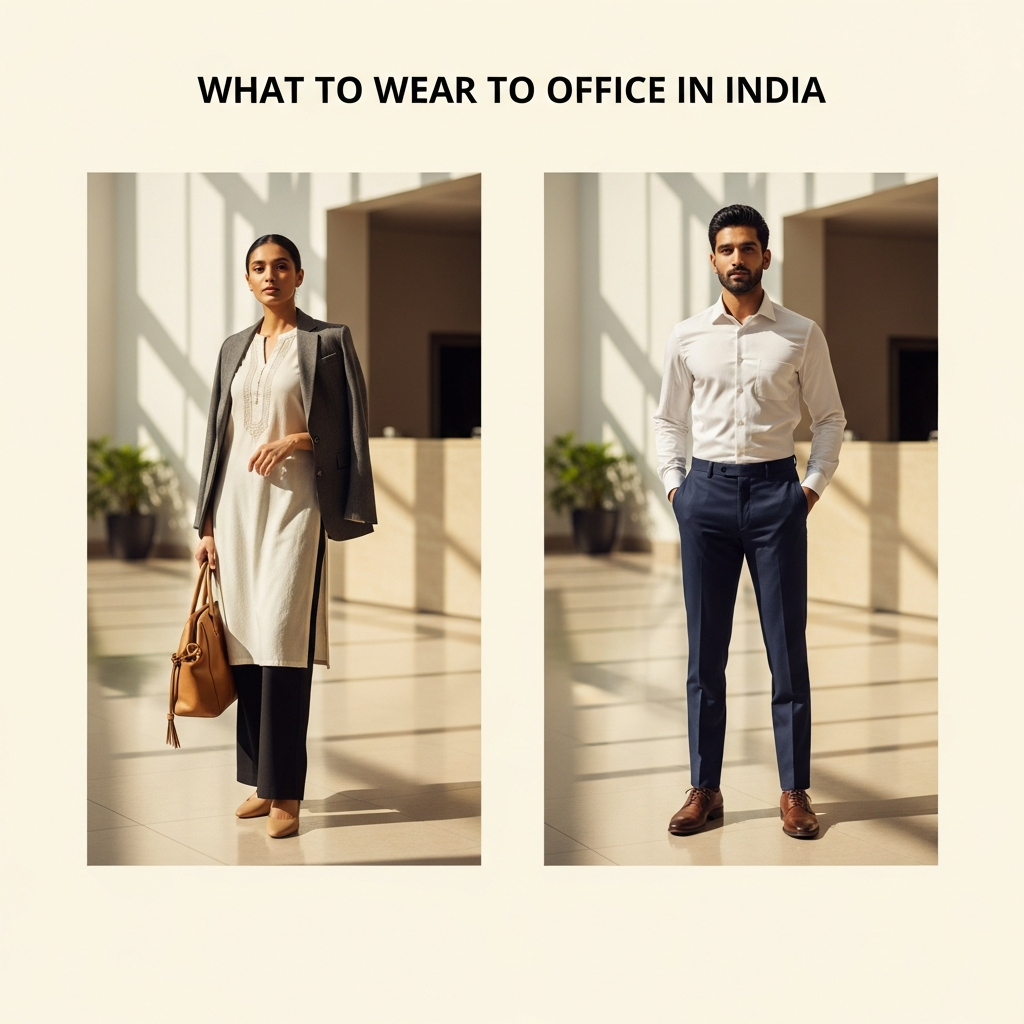
What to Wear to Office in India (Complete Smart & Business Casual Guide)

- #officewearindia
- #workoutfits
- #corporatestyle
- #businessfashion
- #professionaldressing
- #businesscasualindia
- #smartcasual
- #whattowearoffice
'Business casual' is the most misunderstood dress code in Indian workplaces.
Some people interpret it as dark jeans and a collared shirt. Others think it means a full formal suit minus the tie. Some arrive in chappals and a kurta. Others spend their morning anxious about whether a blazer is 'too much.' All of them are making the same underlying mistake: guessing at a code that has real rules.
The reality is that Indian office dressing is not one dress code — it's a spectrum with three distinct tiers, and your job is to identify which tier your workplace sits in and dress accordingly. Get this right, and you'll never second-guess yourself on a Monday morning again.
This guide gives you the complete framework: the three tiers, outfit formulas for men and women, an industry-by-industry breakdown, the most common mistakes, and a weekly planning system that eliminates morning decision fatigue permanently.
Office dressing in India is a skill with rules. Once you know the rules, it becomes effortless. Here they are.
The 3 Indian Office Dress Code Tiers
Before picking an outfit, you need to know which tier your workplace belongs to. Most Indian offices fall clearly into one of three:
Tier 1 — Business Formal
Dark suits, formal sarees, structured salwar-kameez in conservative fabrics. This is the code for banking, law, government, consulting client meetings, and senior leadership interactions. No exceptions, no interpretations. If you work in Tier 1, err on the side of more formal rather than less — every single day.
-
Men: Dark suit (navy, charcoal, black) + formal shirt + tie when required + polished leather shoes. No chinos. No loafers in client-facing settings.
-
Women: Formal saree, structured salwar-kameez in conservative fabrics (no casual cotton prints), or formal trouser suit. Minimal jewellery. Closed-toe heels or formal flats.
Tier 2 — Smart Casual
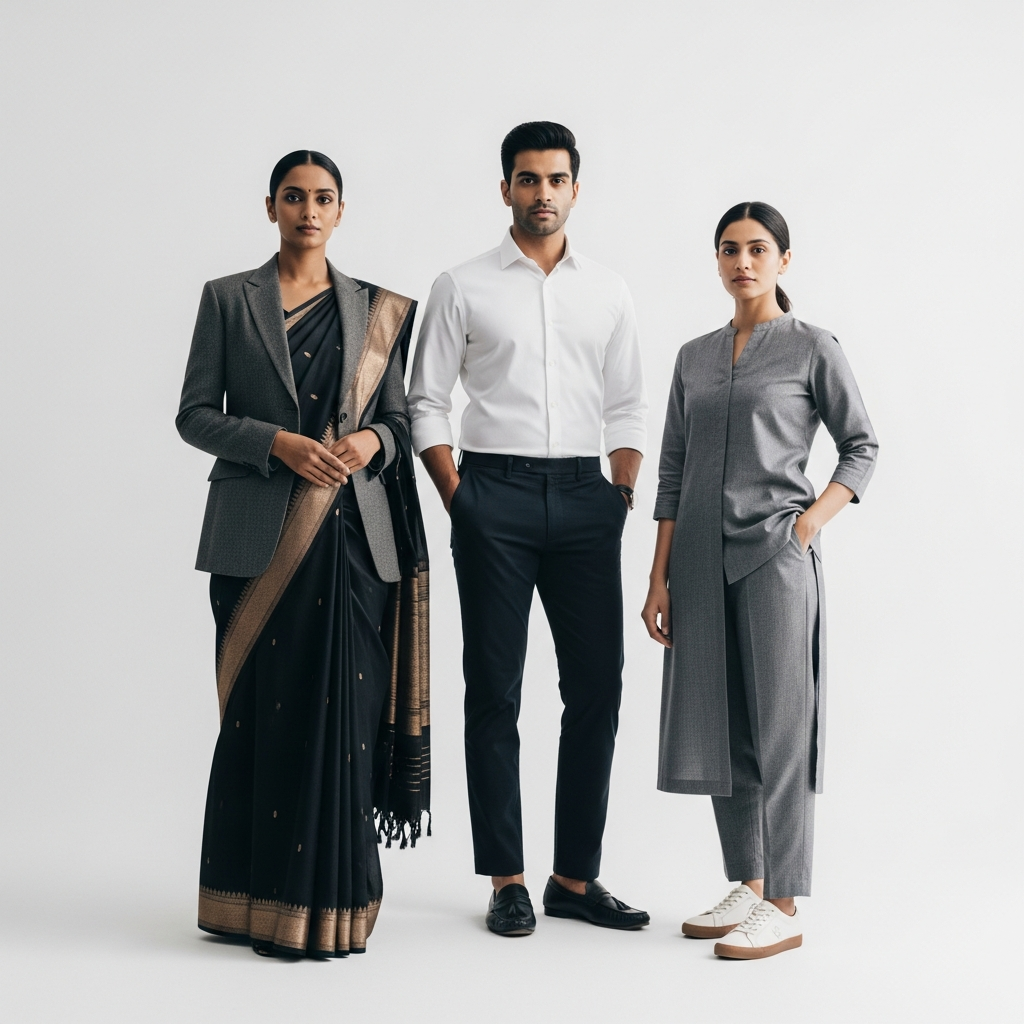
Collared shirts and blouses, structured trousers, kurtas that are clean and well-pressed. This is the day-to-day code for most MNC offices, corporate teams, mid-senior professionals, and hybrid workplaces. It's the most common tier in urban India — and the most frequently misread one.
-
Men: Formal or chino trouser + collared shirt (tucked or smart-untucked for casual Fridays) + leather loafer or formal shoe. Blazer optional but recommended for meetings.
-
Women: Structured trouser or midi skirt + blouse or kurta + blazer or cardigan. Saree is always appropriate at this tier and often reads as elevated. Dupatta optional but adds polish.
Tier 3 — Business Casual
Clean, put-together casuals. This applies to startups, creative agencies, tech companies, and most Bangalore/Hyderabad offices operating in a relaxed culture. 'Business casual' does not mean 'whatever you feel like.' It means casual clothes worn with intentionality — clean, coordinated, and appropriate.
-
Men: Dark jeans or chinos + polo or casual collared shirt + clean sneakers or loafers. No logos. No wrinkles. No sports footwear.
-
Women: Contemporary kurta-set, structured co-ord, or smart jeans + neat top. Clean footwear. One accessory to indicate effort.
💡 When in doubt about your tier, observe the most senior person in your team who's widely respected. Their day-to-day dressing is your benchmark, not the most casual person in the office.
Office Outfit Formula for Women in India
Across all three tiers, a reliable structure for women's office dressing is the 3-piece formula:
Bottom + Top + Layer = Complete Office Outfit
-
Bottom: Formal trouser, tailored skirt, saree, or salwar. This is your foundation piece — choose a neutral or muted colour that works with multiple tops.
-
Top: Formal blouse, kurta, or collared shirt. The ethnic integration rule: a kurta works as your top when it has a clean hemline, sits at mid-thigh or below, and is in a fabric appropriate to the office (cotton, linen, silk — not heavily embroidered or embellished for daily wear).
-
Layer: A blazer for Tier 1 and Tier 2 formal meetings, a structured cardigan for daily AC office wear, or a dupatta for ethnic combinations. Never skip the layer entirely in formal settings.
Seasonal Adjustments
-
Summer (March–June): Cotton, linen, khadi, and cotton-silk blends. Breathable fabrics that maintain structure. Avoid polyester — it wilts in Indian summer heat and shows it.
-
Monsoon: Avoid silk and heavy fabrics that absorb moisture. Stick to cotton and linen. Keep a light layer for the AC temperature swing between outdoors and indoors.
-
Winter (Delhi/North India): Fine-knit sweaters, wool blends, heavier fabrics. A well-fitted jacket over the usual formula works at every tier.
For a deeper understanding of how to navigate the full professional appearance picture — not just outfit selection but grooming and overall presentation — our complete workplace grooming guide covers the entire professional dressing spectrum in detail.
Office Outfit Formula for Men in India
The same 3-piece structure applies for men, slightly adapted:
Bottom + Top + Detail = Complete Office Outfit
-
Bottom: Formal trouser for Tier 1 and Tier 2 (navy, grey, black, charcoal). Dark chino for Tier 2 and Tier 3. Dark straight-cut jeans for Tier 3 only.
-
Top: Collared shirt for all tiers — the non-negotiable. Formal kurta is appropriate for all tiers on appropriate occasions. T-shirts belong in Tier 3 only, and only quality plain or minimal-print ones.
-
Detail: This is what separates a put-together look from a forgettable one. Clean, polished shoes (see hierarchy below). A belt that matches the shoe leather. A structured watch. A bag or portfolio rather than a backpack for Tier 1 settings.
The Indian Office Shoe Hierarchy for Men
-
Formal leather Oxford or Derby — Tier 1 always, Tier 2 for important meetings
-
Leather loafer — Tier 2 everyday, Tier 3 dressed-up occasions
-
Clean, minimal leather or canvas sneaker — Tier 3 only. No sports shoes, no visible logos
When Ethnic Wear Works for Men
A clean, well-pressed formal kurta in a muted colour (ivory, white, dusty blue, sage green) with formal trousers and leather shoes is appropriate at Tier 2 and above on most days. Many Indian offices actively appreciate it on Fridays. For Tier 1 client meetings, ethnic wear needs to be in quality fabric and immaculately pressed — it commands respect when worn right.
Industry-by-Industry Office Dress Code Guide
Your industry's culture determines your tier. Here's the breakdown:
-
Banking and Finance: Always Tier 1. Always conservative. Mumbai financial district offices set the standard — dark colours, formal fabrics, minimal expression. Never Tier 2 for client-facing roles.
-
IT and Technology: Primarily Tier 2 to Tier 3. Bangalore and Hyderabad tech offices are the most relaxed in India. Tier 3 is the daily standard; Tier 2 for all-hands, client visits, and leadership interactions.
-
Management Consulting: Tier 1 as a baseline, calibrated one tier above the client you're meeting. If the client is a startup — Tier 2. If the client is a bank — Tier 1. When uncertain: overdress.
-
Startups: Tier 3, with individual personality allowed. The rule: clean, intentional, and coordinated. Express your aesthetic but never appear careless.
-
Government and PSU: Tier 1 and conservative, always. Traditional and well-pressed is the standard expectation — both for men and women. Under-dressing here is a significant negative signal.
-
Media and Creative Agencies: Tier 3 with genuine creative latitude. Individual aesthetic expression is expected and valued. The standard isn't formality — it's intentionality and coherence.
-
Healthcare and Pharma: Clean, practical, and conservative. Clinical settings favour Tier 1-2. Pharma sales and corporate roles lean Tier 2. The signal to send: competence and reliability over style.
For practical guidance on how to dress professionally across different Indian work environments — including specific outfit examples — our guide on how to dress professionally for work breaks down the specifics by setting and situation.
The 5 Most Common Office Dressing Mistakes in India
Knowing what to wear matters. Knowing what not to wear matters equally.
-
Wearing formal shoes with casual clothes — or vice versa. The shoe is the most visible signal of how seriously you've taken the dress code. A polished leather Oxford with jeans looks confused. Clean sneakers with a blazer look intentional. Match your footwear to your outfit's tier, not your preference.
-
Untucked shirts in formal settings. A formal or semi-formal shirt worn untucked at a Tier 1 office reads as careless. The tuck rule: if the shirt has a straight hem, wearing it untucked is designed-in. If the hem is curved or longer at the back, it's designed to be tucked. Follow the shirt's intent.
-
Kurta without a dupatta in conservative offices. In traditional corporate environments (banking, law, government), a salwar-kameez worn without a dupatta can read as incomplete. The dupatta is part of the outfit — not optional accessory — in these contexts.
-
Wrinkled clothes in any setting. No dress code tier permits wrinkled clothes. A wrinkled formal shirt at a Tier 1 office is worse than a well-pressed casual shirt at a Tier 3 office. Creases communicate: 'I didn't prepare.' Steam or iron every outfit before wearing it.
-
Over-casual footwear regardless of dress code tier. Chappals, sports sandals, and slides in professional settings — even Tier 3 tech offices — read as disrespectful of the context. The baseline for any office setting in India is a clean, structured shoe. No exceptions.
The Monday-to-Friday Outfit Rotation System
The most effective way to eliminate morning wardrobe stress is to move the decision to Sunday. Here's a 30-minute system that works for every tier:
-
Monday (Formal): Your most formal outfit of the week. Sets the professional tone. Tier 1: full business formal. Tier 2: blazer + formal trouser. Tier 3: your sharpest smart-casual look.
-
Tuesday (Smart Casual): Structured and polished but slightly more relaxed than Monday. A trusted mid-tier outfit.
-
Wednesday (Mid-Week Repeat / Ethnic): Midweek is a good day to rotate in an ethnic piece — formal kurta, smart salwar-kameez. It refreshes the week without breaking the dress code.
-
Thursday (Smart Casual): A second smart-casual day. Rotate different pieces from Tuesday to avoid repeating the exact look.
-
Friday (Relaxed Tier): One tier more relaxed than the rest of your week. Friday casual in a Tier 1 office means Tier 2. Friday casual in Tier 2 means Tier 3. This is your personality day — use it within the tier's rules.
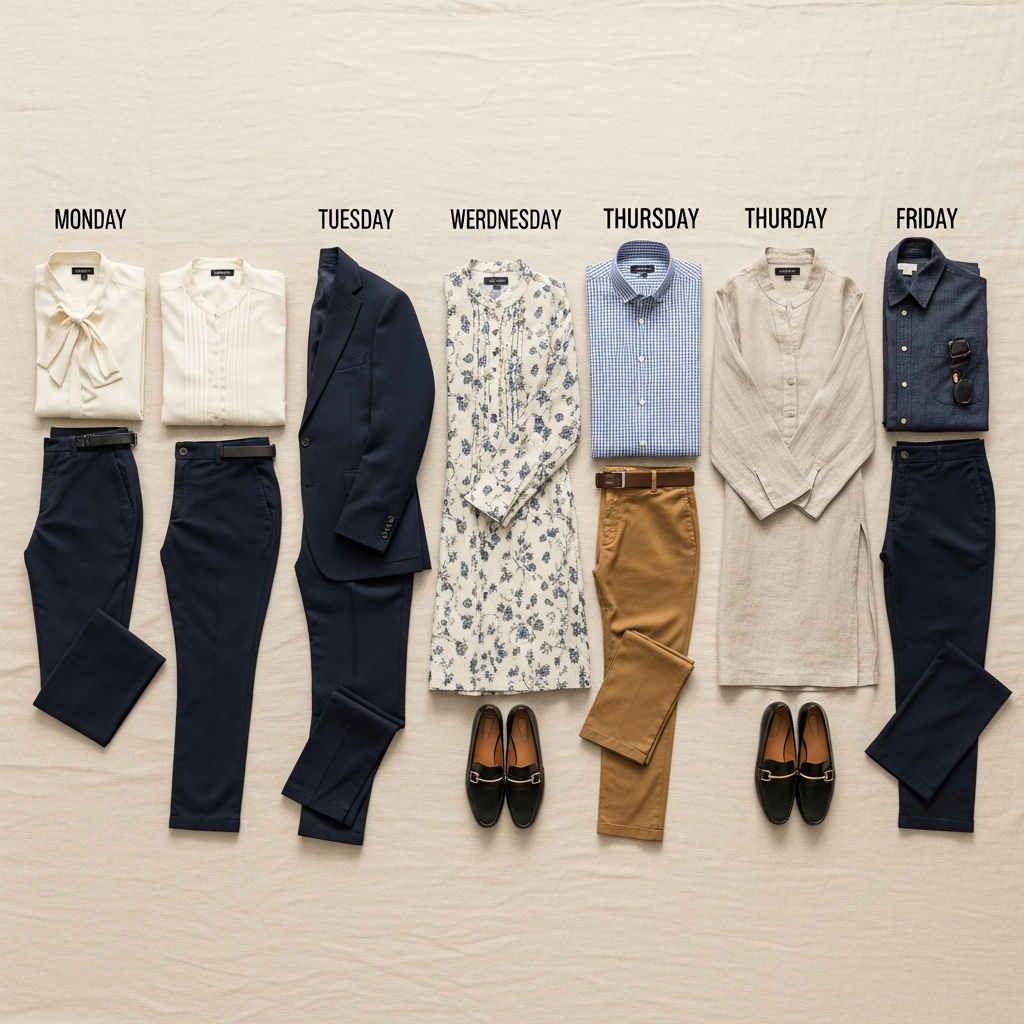
Plan five outfits on Sunday in 30 minutes. Hang them in order. Your morning routine drops from 20 minutes of decision-making to 2 minutes of dressing.
How StyleBuddy Can Help
Knowing the framework is step one. Building a wardrobe that executes it every day is the actual challenge — and that's where most Indian professionals get stuck.
StyleBuddy's workwear styling service builds an office wardrobe calibrated to your specific industry, city, and dress code tier. Our stylists audit your existing wardrobe, identify the gaps that are causing your daily dressing confusion, and create a precise plan for what to keep, what to buy, and exactly how to wear it.
Virtual sessions available pan-India. In-person styling sessions across 35+ cities.
See what StyleBuddy's workwear styling service includes and how it works at stylebuddy.in/styling-services/workwear-styling.
The Bottom Line
Office dressing in India is not a guessing game. It's a skill with a framework — and once you have the framework, every morning becomes straightforward.
Know your tier. Apply the 3-piece formula. Learn your industry's code. Plan your week on Sunday. Fix the five common mistakes. And let your outfit communicate what you want it to communicate before you've said a word.
Want to build a workwear wardrobe that gets this right from day one? Book a free StyleBuddy style assessment — our workwear stylists will map your industry, your current wardrobe, and your gaps, and give you a precise plan that works.