

Wardrobe Makeover: How to Fix a Closet Full Of Clothes But 'Nothing To Wear'

- #wardrobemakeover
- #closetmakeover
- #wardrobedeclutterideas
- #wardrobeproblems
- #capsulewardrobereset
- #wardroberefreshideas
- #declutteringclothesguide
You open your wardrobe every morning and feel nothing.
Not "I have nothing to wear" — you can see the clothes. Rows of them. Kurtas, trousers, sarees, blazers, shirts you bought with good intentions and barely wear. It's more like: "Nothing here feels right." You stand there for ten minutes, reach for the same three things you always reach for, and close the door on everything else.
That's not a wardrobe problem. It's a system problem. And it has a fix.
A wardrobe makeover — a real one, not a shopping trip — is a structural reset. It diagnoses why your existing wardrobe isn't working, removes what's contributing to the confusion, and builds a set of reliable outfit formulas so that every morning becomes a reference, not an experiment.
This post gives you the complete wardrobe makeover process in four steps. No new clothes required to start.
WHY YOUR WARDROBE FEELS FULL BUT FAILS YOU
Before the fix, the diagnosis. The "full wardrobe, nothing to wear" feeling — one of the most reported style frustrations in India — is almost always caused by one or more of three structural failures. Understanding which one is yours determines which part of the wardrobe makeover to prioritise.
REASON 1: TOO MANY OCCASION-SPECIFIC PIECES, TOO FEW EVERYDAY PIECES
Most Indian wardrobes are built around events — weddings, festivals, office formals — rather than around daily life. The result: 3–4 formal ethnic outfits that get worn twice a year, and fewer than 3 reliable everyday outfits that get worn constantly until they're worn out. The wardrobe looks full. It functions empty.
A closet makeover that fixes wardrobe problems starts by rebalancing this ratio. Your daily life should have the most wardrobe real estate, not your once-a-year occasions.
REASON 2: PIECES THAT DON'T TALK TO EACH OTHER
Wardrobe declutter ideas often focus on removing things. The deeper issue is frequently coordination — pieces that were bought as individual items that appealed in the moment, not as part of a connected wardrobe. A white linen blouse that works with nothing else you own. A formal kurta that has no trouser match. An expensive blazer that sits unworn because you've never paired it with anything.
Fixing wardrobe problems at this level means identifying the coordination gaps — the connective tissue your wardrobe is missing — not just removing what doesn't fit.
REASON 3: NO OUTFIT FORMULAS
The third and most common cause of daily wardrobe paralysis: you've never documented what "this works" looks like. Every morning is a fresh experiment. You pull things out, try combinations, discard them, and eventually grab something familiar. The clothes aren't the problem — the absence of a system is.
A wardrobe refresh that actually sticks doesn't just declutter. It builds a set of proven outfit formulas that make daily dressing a reference, not a decision.
THE 4-STEP WARDROBE MAKEOVER PROCESS
This is the core of the wardrobe makeover. Set aside two hours. Do it properly once. The results are permanent.
STEP 1 — THE EMPTY-OUT (30 MINUTES)
Take every single item out of your wardrobe. Everything — on the bed, on chairs, on the floor if needed. The physical act of seeing your entire wardrobe at once is essential: it breaks the illusion that you "don't have anything" and forces an honest look at what you actually own.
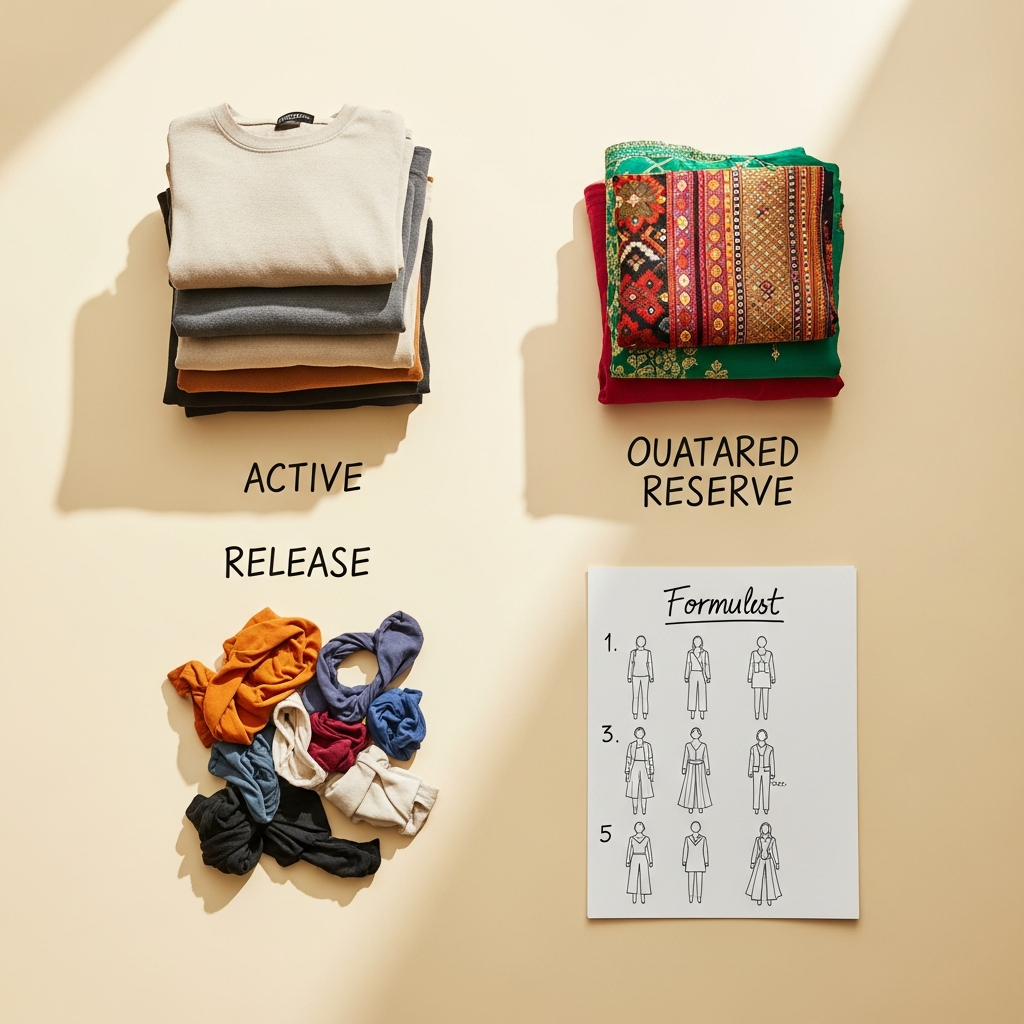
Sort everything into three piles as you remove it:
• Active: worn in the last 6 months
• Reserve: occasion-specific but intentional — you know when you'll wear it
• Release: everything else
STEP 2 — THE WARDROBE AUDIT (45 MINUTES)
With your Active pile assembled, do a structured wardrobe audit:
Count by category: how many bottoms, how many tops, how many ethnic pieces, how many layering pieces, how many shoes. Most Indians discover they are significantly over-indexed in one category and starved in another.
Identify coordination gaps: for every bottom, ask — how many tops does it work with? If the answer is 0 or 1, that bottom is a dead piece despite being Active. Mark it for potential release or as a gap that needs a coordinating top.
Review the Reserve pile critically: anything in Reserve with no specific occasion in the next 6 months should be moved to Release. "I might need this someday" is not an occasion.
STEP 3 — THE FORMULA BUILD (30 MINUTES)
This is the step most wardrobe organization tips skip — and it's the most important one.
From your Active pile, identify 5 proven outfit combinations: outfits you have actually worn, received positive feedback on, or felt genuinely good in. Write them down. Photograph them if possible.
Structure: Base (bottom or ethnic anchor) + Top + Layer + Shoe + Accessory.
Example: Black straight-cut trousers + ivory silk blouse + navy blazer + tan loafer + gold stud. You know this works. Document it. It is now Outfit Formula 1 — a reliable reference for any formal office day.
These 5 formulas are your wardrobe refresh anchors. They are what the rest of your wardrobe makeover will be built around.
STEP 4 — THE GAP LIST (15 MINUTES)
With 5 documented outfit formulas, you can now see clearly what's missing. A formula that needs one more blouse in a specific colour. A bottom that has no reliable shoe match. A formula that falls apart because the only bag you own is too casual.
Your Gap List is your shopping list. It contains only items that complete an existing formula. Nothing else. This single discipline — buying only to close a gap, not to explore a possibility — is what transforms a wardrobe makeover from a one-time reset into a permanent system.
For a complete step-by-step wardrobe makeover guide including how to identify your style gaps and build a shopping strategy around them:
THE CAPSULE WARDROBE RESET
After completing the 4-step process, most people find themselves with 15–20 Active pieces. This is your capsule wardrobe reset — the stripped-back, functional core of your wardrobe.
The capsule wardrobe reset principle: 15–20 pieces should generate at least 30 distinct outfits. If they don't, the issue is coordination, not volume. Before buying anything new, ask whether the problem is a missing piece or a pairing you haven't tried yet.
The math works like this:
• 5 bottoms × 4 tops each = 20 combinations
• Add 2 layering pieces × 5 each = 10 more
• Add 2 ethnic anchor pieces × 3 styling variations = 6 more
• Total: 36+ distinct looks from 15–20 pieces
This is why a capsule wardrobe reset works better than a shopping trip. Volume was never the issue.
For a detailed guide to building a capsule wardrobe system as an Indian professional — including the right pieces to anchor it and how to make ethnic and western pieces work together:
WHAT TO DO WITH THE RELEASE PILE
Before you bag everything in the Release pile and donate it, a strategic pass-through will save you from releasing things worth keeping and help you monetise the rest.
CHECK 1 — CAN TAILORING SAVE IT?
A quality piece in the wrong size, with a hemline that's too long, or a waist that's too wide can often be rescued for ₹200–₹500. Before releasing any high-quality item, ask: would this work if it fit properly?
CHECK 2 — CAN A DIFFERENT PAIRING ACTIVATE IT?
Some pieces are dead because they've never been paired correctly. Take the Release pile item and ask: is there anything in the Active pile it could work with that you haven't tried? If yes, it moves to Active provisionally — test the pairing before permanently releasing.
CHECK 3 — IS IT SEASONAL?
A piece that genuinely doesn't work for the current season or occasion cluster doesn't need to be released — it needs to be stored. A wool blazer in summer. A festive lehenga with no function for 8 months. Store, don't release.
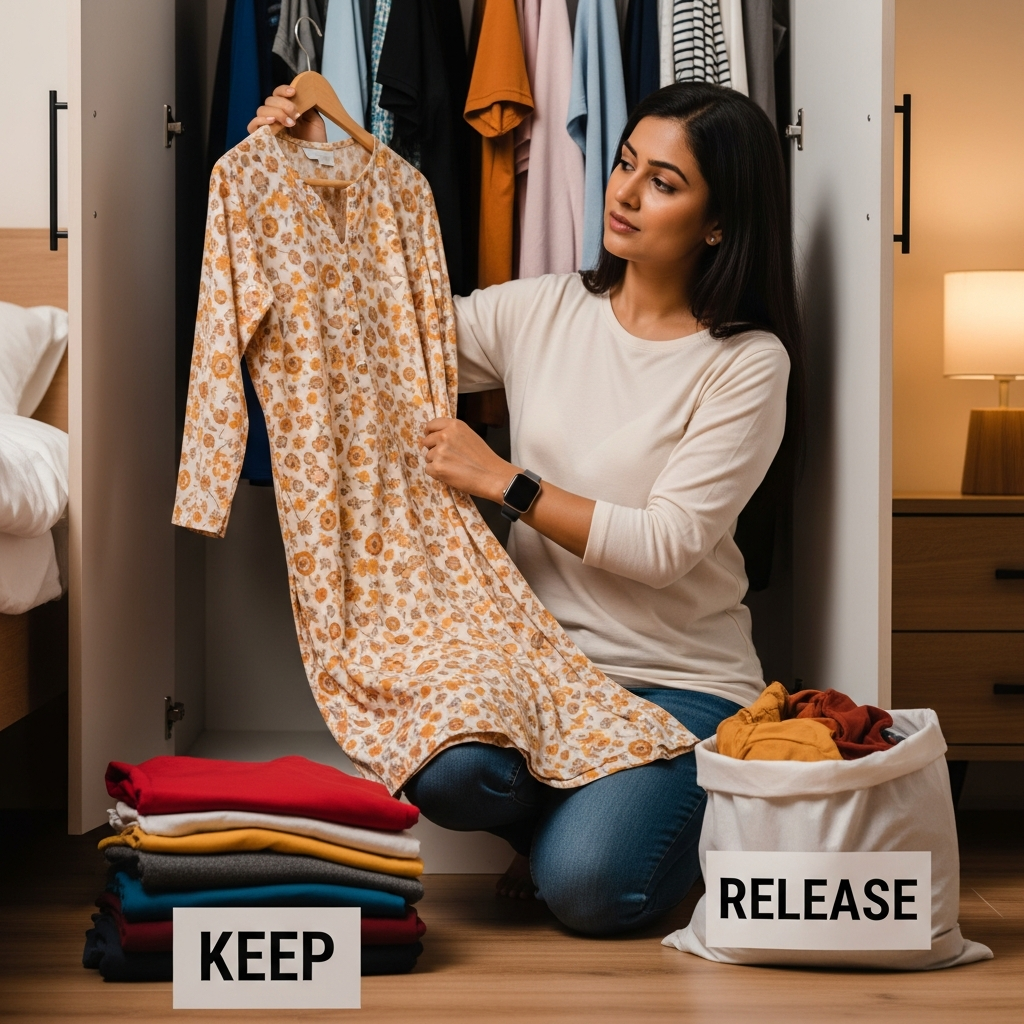
ONCE THE PASS-THROUGH IS DONE:
• Donate: clothes in reasonable condition to local NGOs, gurudwaras, or community organisations
• Sell: quality items on OLX, Poshmark India, or local resale groups — a structured decluttering clothes guide should always include a sell strategy
• Repurpose: dupatta → stole, kurta → layering piece, formal trouser → casual trouser with a simple hem shortening
BUILDING NEW OUTFIT FORMULAS POST-MAKEOVER
Once your wardrobe makeover is complete and new Gap List items are added, it's time to extend your formula set beyond the original 5.
THE FORMULA BUILDING PROCESS:
For each Active bottom: identify 3 distinct top combinations that work. If you can only identify 1 or 2, note the gap.
For each ethnic anchor piece: identify at least 2 distinct styling variations using different:
• Jewellery (statement vs minimal)
• Bag (formal structured vs casual tote)
• Drape or tuck variation (if saree)
• Shoes (block heel vs flat vs ethnic)
DOCUMENT EVERYTHING:
Photograph each formula — even a quick phone photo is enough. This turns your wardrobe makeover into a permanent reference system. Morning decisions drop from 10–15 minutes of experimentation to 2 minutes of reference.
Good wardrobe organization tips always include this documentation step. A wardrobe that is physically reorganised but mentally undocumented will drift back into chaos within 3 months.
WHEN A WARDROBE MAKEOVER NEEDS PROFESSIONAL HELP
The DIY process above works well for most people with functional wardrobes and coordination issues. There are four situations where professional help adds significant value that the DIY process cannot replicate:
• You have done this yourself before and the wardrobe chaos returned within 6 months. The issue is a buying habit, not a decluttering gap. A stylist identifies the habit pattern.
• You've had a major life change — a new job, a significant weight change, a move to a new city, a relationship change. Your wardrobe was built for a version of your life that no longer exists.
• You genuinely don't know what suits your body type or lifestyle, so the formula-building step always produces the same 2–3 outfits. A stylist's eye sees combinations and fits you can't see for yourself.
• You are spending on new clothes regularly but still experiencing the same wardrobe frustration. This means the Gap List logic is broken — you're buying the wrong things. A professional wardrobe audit resets the logic.
HOW STYLEBUDDY CAN HELP
StyleBuddy's wardrobe makeover service includes all four steps above — the empty-out, the wardrobe audit, the formula build, and the gap list — done with you by a trained stylist who can see what you can't see about your own wardrobe.
Most clients report using 3x more of their existing wardrobe after a single session. Not because they bought more — because a professional identified the coordination and formula gaps that were keeping 60–70% of their wardrobe inactive.
Virtual wardrobe makeover sessions available pan-India from ₹3,000. In-person wardrobe makeover sessions available across 35+ cities.
See what StyleBuddy's wardrobe makeover service includes, how long it takes, and what it costs:
THE BOTTOM LINE
The wardrobe makeover you need is not a shopping trip. It's a system reset.
A closet makeover that actually fixes wardrobe problems — permanently — diagnoses the root cause, removes the clutter strategically, builds a capsule wardrobe reset from what works, and documents the outfit formulas that make daily dressing reliable.
Start with the 4 steps above. Two hours this weekend. The result is a wardrobe that works every morning — not three items out of fifty.
Book a StyleBuddy wardrobe makeover and have a professional do it properly, once.