

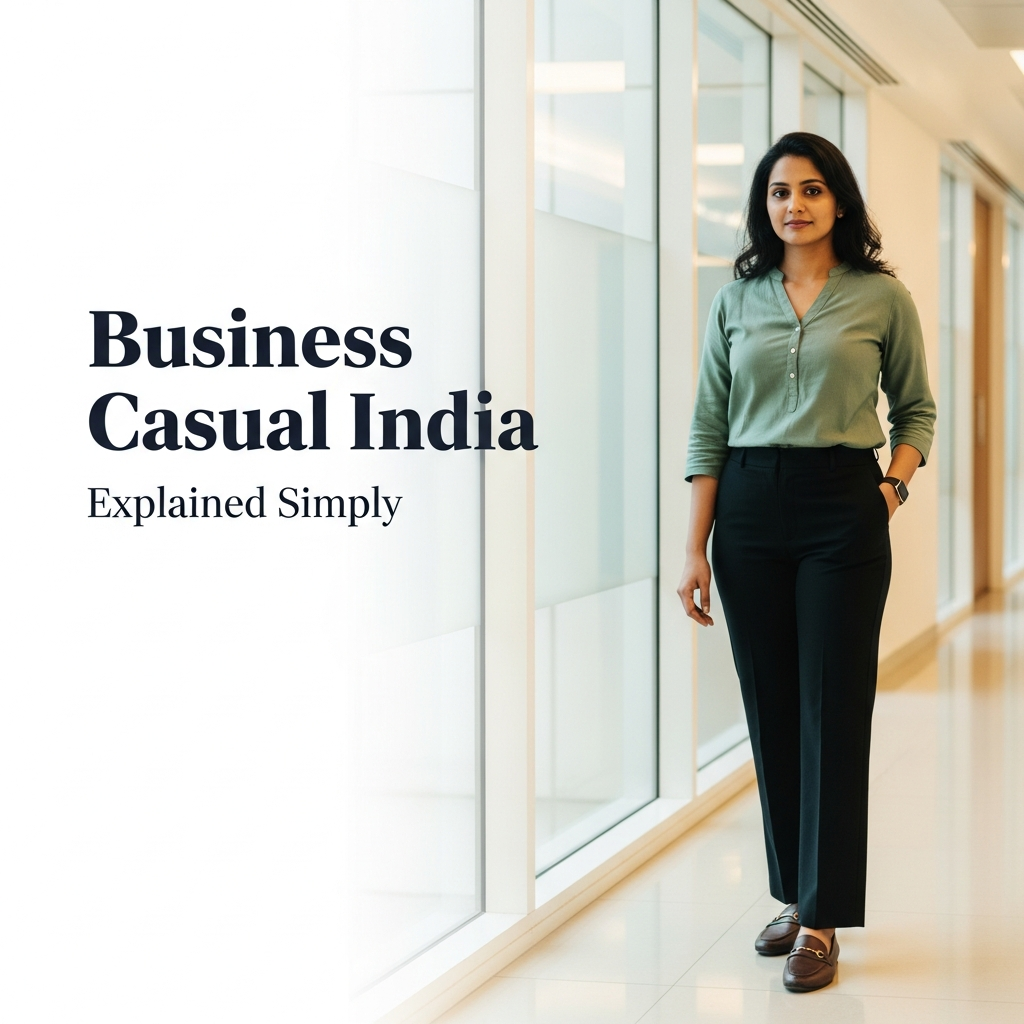
Business Casual for Men and Women in India Explained Simply

- #businesscasualindia
- #whatisbusinesscasual
- #officedresscode
- #smartcasualvsbusinesscasual
- #startupdresscodeindia
- #officecasualoutfitsmen
- #officecasualoutfitswomen
- #corporatecasualattire
- #semiformaloutfitsindia
Ask 10 people in an Indian office what 'business casual' means and you'll get 10 different outfits.
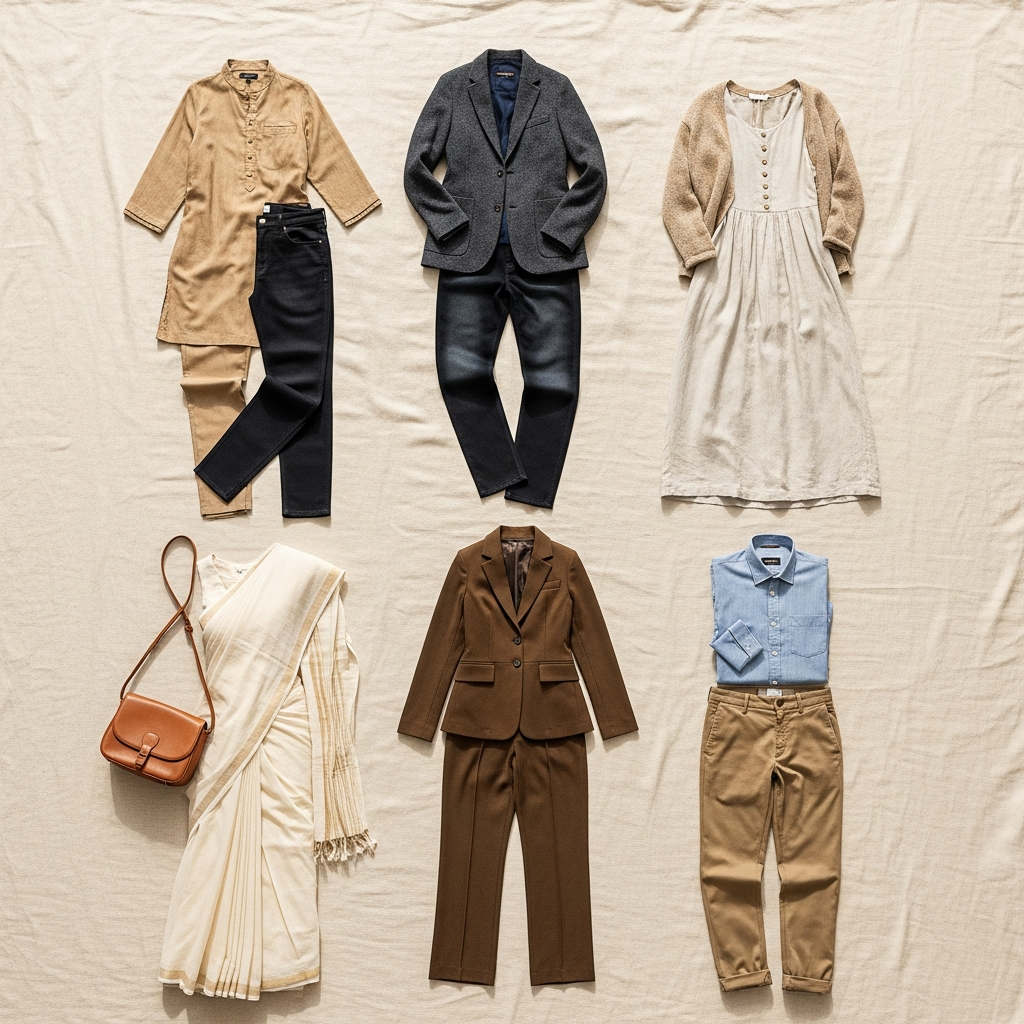
A saree. Dark jeans and a blazer. A kurta. Formal trousers and a polo shirt. They're all in the same meeting. All of them think they're dressed appropriately. Only some of them are right.
Business casual is the most poorly defined dress code in Indian professional life — and that ambiguity has real consequences. You either overthink it (arriving over-dressed and uncomfortable) or under-think it (arriving under-dressed and unprofessional).
This post decodes it clearly. You'll leave with a working definition, a comparison against other dress codes, 12 specific outfit formulas for men and women, industry calibration rules, and the three things that ruin a business casual look the moment you walk in.
Already read our guide on what to wear to office in India? This post goes deeper on the business casual tier specifically — the most misunderstood of the three dress code levels.
Business casual isn't a specific outfit. It's a standard. Once you understand the standard, every outfit decision inside it becomes straightforward.
What Business Casual Actually Means in India
Here is the most useful working definition:
Dressed more intentionally than your weekend clothes, but more relaxed than a formal business meeting.
The line is not about fabric or ethnicity. A kurta is business casual. A silk saree is business casual. Dark jeans with a blazer are business casual. What makes something business casual is intentionality — clothes that are clean, well-fitted, and assembled as a considered outfit rather than grabbed off the floor.
What is not business casual: a wrinkled t-shirt. Track pants. Sports sandals. Casual salwar with visible wear and tear. Anything you would wear to run errands on a Sunday morning.
💡 The quickest test: would you feel confident walking into a client call in this outfit? If yes — it's business casual. If you'd want to change first — it isn't.
Business Casual vs Smart Casual vs Formal — The Indian Breakdown
The Indian office dress code operates on a spectrum. Here is how the four levels map to real contexts:
Business Formal
-
Dark suit / formal saree / formal salwar-kameez in structured fabric
-
Polished leather shoes or formal heels
-
Applies to: banking, law, government, senior client meetings, board presentations
Business Casual
-
Structured outfit — kurta + trouser, blouse + skirt, chinos + shirt — no tie required
-
Smart footwear — loafer, block heel, leather sandal — clean and appropriate
-
Applies to: MNC daily, corporate casual Fridays, most team meetings
Smart Casual
-
Neat casuals with one formal element — clean jeans + blazer, casual kurta + nice shoes
-
Applies to: startup office, off-site work events, casual client interactions
Casual
-
Comfortable everyday wear — no structured element required
-
Applies to: work-from-home days, internal creative sessions in very casual companies
Business Casual for Women in India — 6 Outfit Formulas
Each formula below is broken down by what makes it business casual — not formal, not casual.
Formula 1 — The Everyday Professional
▸ Straight-cut kurta (mid-thigh, clean hem, minimal embellishment)
▸ Tailored straight-cut trouser in navy, black, or grey
▸ Block heel or leather loafer
▸ Why it's business casual: structured silhouette, ethnic piece in a professional cut
Formula 2 — The Modern Corporate
▸ Formal blouse in silk, cotton-silk, or quality polyester blend
▸ Wide-leg tailored trouser in a neutral
▸ Minimal gold or silver jewellery
▸ Why it's business casual: elevated western formula, no blazer needed in warm offices
Formula 3 — The Smart Summer Option
▸ Linen midi dress in a muted tone (dusty blue, warm beige, olive)
▸ Structured cardigan or light blazer
▸ Block heel or clean mule
▸ Why it's business casual: the cardigan bridges casual dress into professional territory
Formula 4 — The Saree Professional
▸ Cotton or cotton-silk saree in a solid or small print
▸ Contemporary blouse (collared, western cut, or structured)
▸ Quality leather bag
▸ Why it's business casual: a saree is always professional — the contemporary blouse modernises it
Formula 5 — The Structured Co-ord
▸ Matching coord set in structured fabric (not jersey or athleisure)
▸ Leather loafer or pointed flat
▸ One simple accessory
▸ Why it's business casual: cohesion of a matched set reads as intentional, not casual
Formula 6 — The Smart Jeans Day
▸ Dark straight-cut or slim-fit jeans (no distressing)
▸ Silk blouse or structured top (tucked or partially tucked)
▸ Tailored blazer
▸ Why it's business casual: the blazer and silk top elevate jeans to professional territory
For a complete look at how to build a professional wardrobe across all dressing tiers, including fabric choices and grooming — our guide on complete workplace grooming for Indian professionals covers both appearance and outfit structure in full.
Business Casual for Men in India — 6 Outfit Formulas
Formula 1 — The Classic
▸ Chinos in khaki, navy, or grey
▸ Collared shirt (tucked or smart-untucked for smart casual)
▸ Leather loafer
▸ Why it's business casual: the loafer and collared shirt create a professional read without formality
Formula 2 — The Elevated Jeans
▸ Dark straight-cut or slim-fit jeans (dark wash, no distressing)
▸ Formal shirt (tucked)
▸ Structured blazer
▸ Why it's business casual: blazer + formal shirt transforms jeans into a professional outfit
Formula 3 — The Ethnic Office
▸ Linen or cotton kurta in a muted colour (ivory, grey, sage, dusty blue)
▸ Slim formal trouser
▸ Leather mojri or clean leather sandal
▸ Why it's business casual: ethnic wear is unambiguously professional in most Indian offices
Formula 4 — The Polo Professional
▸ Quality polo shirt in navy, white, or grey (no visible branding)
▸ Formal trouser
▸ Leather loafer
▸ Why it's business casual: formal trouser elevates the polo; quality fabric is essential
Formula 5 — The Festive-Office Hybrid
▸ Bandhgala jacket in a rich muted tone (burgundy, navy, charcoal)
▸ Dark formal trouser
▸ Formal leather shoe
▸ Why it's business casual: strong for cultural/festive corporate events; commands quiet authority
Formula 6 — Startup Only
▸ Structured trouser-jogger hybrid in a neutral
▸ Clean white shirt (quality fabric)
▸ Clean minimal sneaker (leather or canvas — no sport branding)
▸ Why it's business casual: works only in Tier 3 / startup environments — not MNC or consulting
Industry-Specific Business Casual Calibration
Business casual looks different across industries because the baseline of 'professional' varies. Here's how to calibrate by context:
-
Startup offices (Tier 3 culture): Business casual here includes Formula 6 for men and structured co-ords for women. Personality expression is welcome. The benchmark: would a senior engineer wear this? Not a CEO.
-
MNC corporate (Tier 2 culture): Business casual means Formulas 1–5 for men, Formulas 1–5 for women. Clean, structured, and intentional. No visible casualness. The benchmark: what does your manager wear on casual Fridays?
-
Consulting (calibrated to client): Business casual only appears on non-client days. The rule: always dress one tier above your client. If client is startup — business casual. If client is bank — business formal.
-
Creative agencies: The most flexible business casual environment. Personality and aesthetic are signals of competence here, not distractions. Formula 5 for women, Formula 6 for men are fully appropriate.
💡 The fastest calibration shortcut: identify the best-dressed, highest-performing person in your team. What do they wear on casual days? That's your business casual floor — not the most casual person in the office.
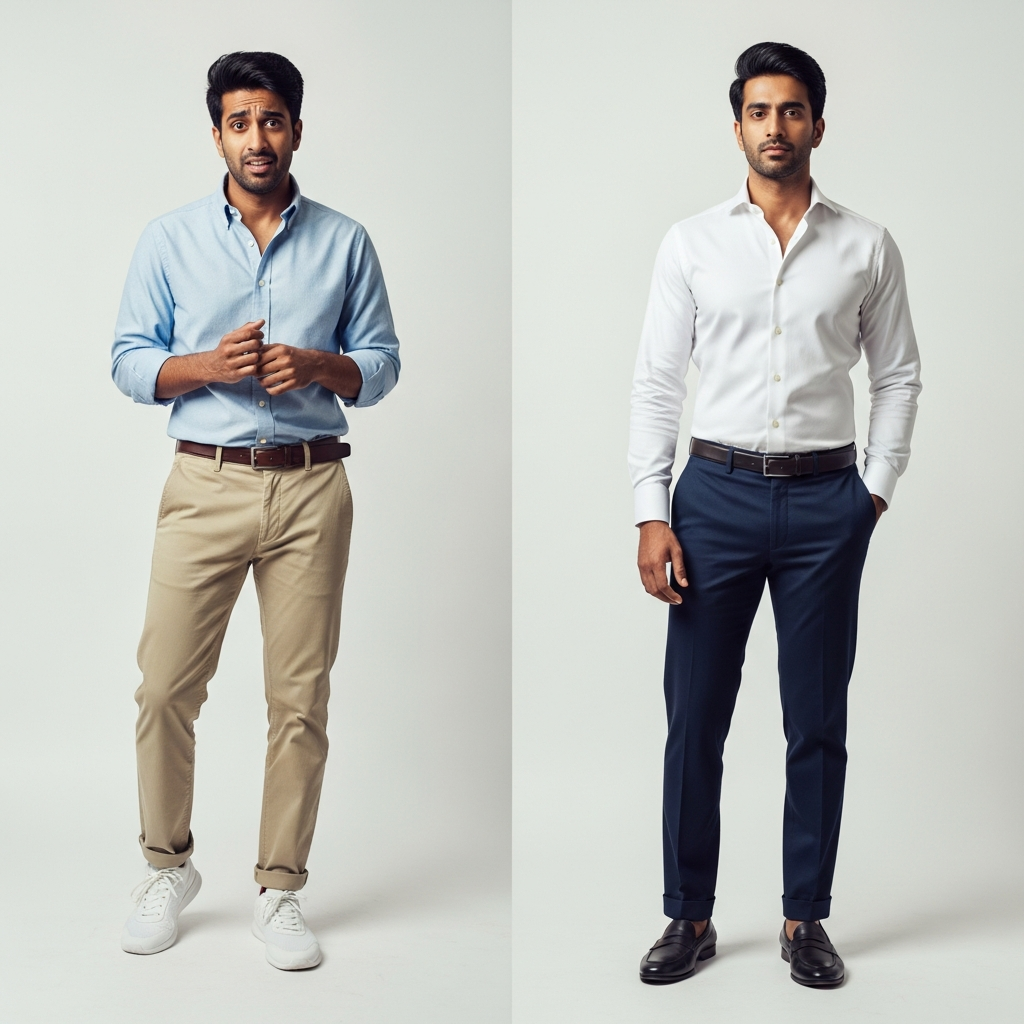
The 3 Things That Ruin a Business Casual Look Instantly
-
Wrong footwear. Sports shoes, chappals, or slides with a structured outfit cancel the professional signal entirely. The footwear must match the formality level of the clothes above it. Business casual footwear minimum: loafer, block heel, leather sandal, or clean leather shoe.
-
Visible wrinkles. Business casual does not excuse wrinkled clothes. A wrinkled kurta reads as careless regardless of how well it fits. Steam or iron every piece before wearing — this alone separates business casual from just casual.
-
Poor fit. Too baggy shifts the read from casual-professional to sloppy. Too tight shifts the read from professional to uncomfortable. Business casual fit standard: clothes that sit on the body without pulling or drooping, with clean lines and a structured silhouette.
For a deeper look at how to nail the business casual dress code in Indian workplaces across different office cultures, our earlier guide covers the full context with additional outfit examples for both metros and smaller cities.
How StyleBuddy Can Help
Knowing the definition and formulas is the starting point. Building a wardrobe that executes business casual correctly — for your specific office culture, body type, and budget — is the actual work.
StyleBuddy's workwear styling sessions decode your specific office dress code, map it to your existing wardrobe, and build a precise plan for what to keep, what to add, and exactly which formula works for your life. No more second-guessing what to wear on Monday.
Virtual sessions available pan-India. In-person styling sessions across 35+ cities.
The Bottom Line
Business casual isn't a specific outfit. It's a standard of dressing that communicates: 'I am professional and approachable.' Once you understand that standard — and know the formulas that meet it — every outfit decision inside it becomes fast and confident.
Pick two formulas that suit your industry and make them your defaults. Get them fitted correctly. Wear the right shoes. Press everything.
That's all business casual is.
Still unsure where your wardrobe lands on the smart casual vs business casual spectrum? Book a free StyleBuddy style assessment — our workwear stylists will map your office culture, audit your wardrobe, and tell you exactly which formulas to build around.